On the web, information is very often encoded by color: a red triangle flags an event, a green background a special offer, a blue dot an active filter.
For a colorblind person, this information can be lost — usually without them even realizing.
Classic daltonization
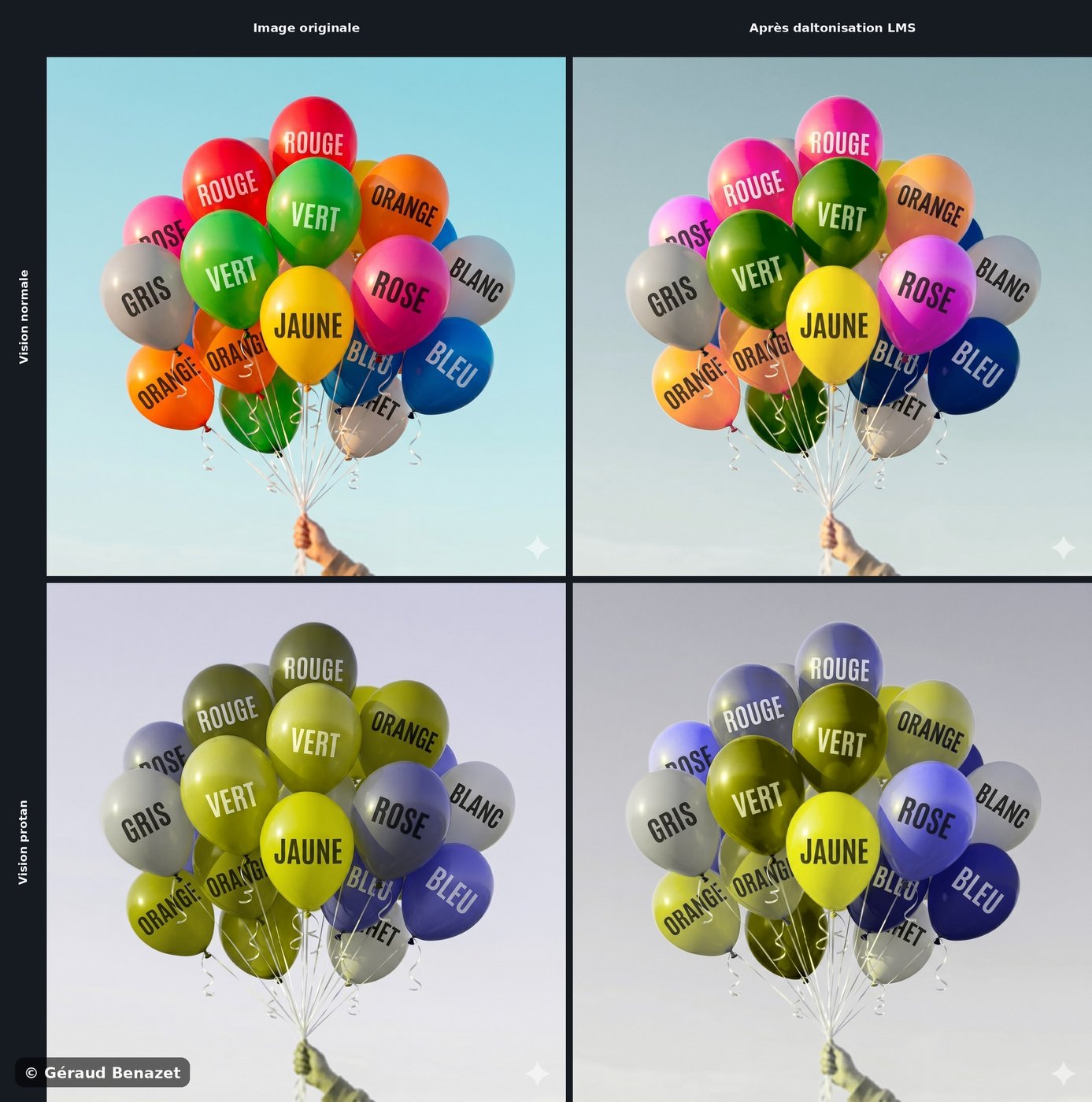
Standard tools apply a global LMS daltonization, a mathematical shift of every color in the color space of the red cones (long wavelength), green (medium), and blue (short). It's mathematically elegant, and useful for a photograph or a painting, where the whole image rebalances smoothly.
But on a map, a chart, when color encodes information, it doesn't help: red and green shift together.
See the illustration: same image seen by a trichromat and a protan, before and after LMS daltonization
Top: what a trichromat sees, before and after LMS daltonization — the change is nearly invisible. Bottom: what a protan sees in both cases — red and green stay merged in the same olive range.
Semantic substitution
Sinople substitutes vivid colors with colors the colorblind viewer clearly distinguishes. Neutral colors (beige, grey, text) are not modified.
We do not try to restore trichromatic vision, we redistribute information-carrying hues onto the axes the colorblind viewer still perceives.
Correction via symbols
When color alone is not enough, we can add a supplementary visual layer, exactly like heraldic tinctures were replaced by hatchings on monochrome engravings of coats of arms:
Hatchings for extended areas (backgrounds, flats, colored surfaces).
Differentiated icons for point-like information (dots, badges, markers).
Why are color names in French?
Color names are kept in French, a small tribute to the project's heraldic roots.
More precisely, the names of heraldic tinctures (the technical term for colors and metals in heraldry) are kept in their medieval form. This vocabulary, shared by French and Anglo-Norman heralds since the 12th century, still survives today in both French and English heraldry. Except for sinople, which English heraldry calls "vert".
The French roots of the project are most visible in the use of Lucky Luke's Dalton brothers, a pun on the homonymy in French between Dalton and « daltonisme » (the French word for color blindness, named after John Dalton, the 18th-century British chemist who was himself colorblind).
Think of it as a feature, not a bug.
The French backronym in the picture roughly reads: "intelligent hue substitution to see screens fully".
Note
By using Sinople you confirm that you are not a moderator of r/colorblind, you are in no way affiliated with the moderation team of r/colorblind, you are not using this app on behalf of a moderator of r/colorblind. To the best of your knowledge, information and belief this application will not make its way into the hands of a moderator of r/colorblind.
This disclaimer is a direct pastiche of Stuart Semple's Pinkest Pink disclaimer, which famously excludes Anish Kapoor from using the pigment. It is adopted here in the same spirit, after the r/colorblind moderation team permanently banned me for announcing this webapp without reply or rationale.
This is done in the same spirit as their publicly stated position :
I am absolutely that petty.
— r/colorblind moderation team
Auto detection
Some colors have been customized. What should we do with those changes?